

Matrix Calculator
Calculate matrix multiplication, inverse matrix, and determinant quickly and accurately.
Matrix A
Matrix B
Result
Matrix Calculator
A matrix calculator is an online tool that makes common matrix calculations faster and easier. Instead of performing every arithmetic step by hand, you can enter the values of your matrices and calculate the result directly.
The calculator above can be used to perform important operations including matrix multiplication, finding the inverse of a matrix, and calculating the determinant. It supports 2 × 2, 3 × 3, and 4 × 4 square matrices and accepts positive numbers, negative numbers, and decimal values.
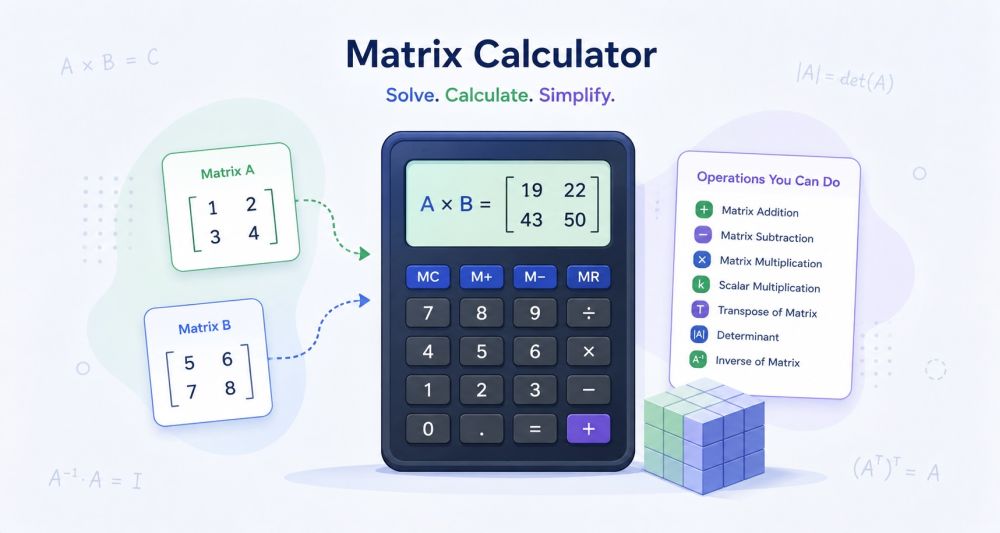
Quick tip: Use the calculator above when you need a quick result, then use the formulas and worked examples below to understand how the calculation is performed.
What Is a Matrix?
A matrix is a rectangular arrangement of numbers or other mathematical elements organized into rows and columns. The individual values inside a matrix are called entries or elements.
A matrix with m rows and n columns has a dimension, or order, of m × n. For example, a matrix with two rows and three columns is called a 2 × 3 matrix.
[ 1 3 4 ]
The matrix above contains two rows and three columns, so its order is 2 × 3. Matrices are fundamental to linear algebra and are widely used for representing systems of equations, transformations, data, and relationships between numerical quantities.
How to Use the Matrix Calculator
You can use the calculator at the top of this page for several common matrix operations. Follow these steps:
- Choose the size of Matrix A.
- Choose the size of Matrix B.
- Enter the values into the matrix cells.
- Select Multiply A × B to calculate the matrix product.
- Select Inverse of A or Inverse of B to calculate a matrix inverse.
- Use the determinant buttons when you need the determinant of Matrix A or Matrix B.
- Review the result displayed below the calculator.
If you are calculating an inverse matrix, remember that the matrix must be square and its determinant must not be zero.
Matrix Multiplication Calculator
A matrix multiplication calculator calculates the product of two matrices. Unlike ordinary multiplication of numbers, matrix multiplication follows a specific row-by-column rule.
Matrix multiplication is possible when the number of columns in the first matrix is equal to the number of rows in the second matrix. If matrix A has dimensions m × n and matrix B has dimensions n × p, their product AB has dimensions m × p.
How Matrix Multiplication Works
Each entry in the resulting matrix is obtained by multiplying the corresponding entries from one row of the first matrix by one column of the second matrix and then adding those products.
[ 3 4 ]
B = [ 5 6 ]
[ 7 8 ]
The first value of AB is obtained by multiplying the first row of A by the first column of B:
Repeating this row-by-column process for every position gives:
[ 43 50 ]
Matrix Multiplication Rules
| First Matrix | Second Matrix | Multiplication Possible? | Result Size |
|---|---|---|---|
| 2 × 2 | 2 × 2 | Yes | 2 × 2 |
| 2 × 3 | 3 × 2 | Yes | 2 × 2 |
| 3 × 2 | 2 × 4 | Yes | 3 × 4 |
| 2 × 3 | 2 × 2 | No | — |
The calculator above currently works with square matrix inputs. The general rule shown here is useful when checking whether two matrices can be multiplied in linear algebra.
Inverse Matrix Calculator
An inverse matrix calculator finds the inverse of an invertible square matrix. The inverse of a matrix A is written as A−1.
The inverse has a special relationship with the original matrix. When A is invertible, multiplying A by its inverse produces the identity matrix.
A−1 × A = I
The identity matrix plays a role similar to the number 1 in ordinary multiplication. For a 2 × 2 matrix, the identity matrix is:
[ 0 1 ]
When Does a Matrix Have an Inverse?
A standard matrix inverse exists only for a square matrix whose determinant is not zero.
Therefore, A is invertible.
If the determinant is zero, the matrix is called a singular matrix and its inverse does not exist. A square matrix with a non-zero determinant is invertible, also called nonsingular.
2 × 2 Matrix Inverse Formula
For a 2 × 2 matrix:
[ c d ]
Its determinant is:
When ad − bc ≠ 0, the inverse is:
[ −c a ]
Matrix Inverse Calculator: Step-by-Step Example
Consider the following matrix:
[ 1 1 ]
First calculate its determinant:
Because the determinant is 1, the matrix is invertible. Using the 2 × 2 inverse formula:
[ −1 2 ]
You can enter the same matrix in the calculator above and select Inverse of A to verify the result.
Determinant of a Matrix
The determinant is a scalar value associated with a square matrix. It provides important information about the matrix and is particularly important when determining whether a matrix is invertible.
For a 2 × 2 matrix:
[ c d ]
det(A) = ad − bc
For larger matrices, determinants can be calculated using methods such as cofactor expansion or row-reduction techniques. The calculator above computes determinants for the supported square matrix sizes.
What Is a Singular Matrix?
A singular matrix is a square matrix whose determinant is zero. Because its determinant is zero, it does not have a standard matrix inverse.
Therefore, if the inverse option in the calculator reports that an inverse cannot be found, check the determinant of the matrix. A zero determinant is the key reason an inverse does not exist.
Matrix Calculator vs. Matrix Multiplication Calculator
These terms are closely related, but they describe slightly different purposes. A matrix calculator is a broader term for a tool that performs one or more operations on matrices. A matrix multiplication calculator specifically focuses on calculating the product of two matrices.
| Tool Type | What It Calculates |
|---|---|
| Matrix Calculator | General matrix operations such as multiplication, determinants, and inverses. |
| Matrix Multiplication Calculator | The product of two compatible matrices. |
| Inverse Matrix Calculator | The inverse of an invertible square matrix. |
| Matrix Inverse Calculator | Another common term for a calculator that finds A−1. |
| Determinant Calculator | The determinant of a square matrix. |
Important Matrix Properties
Understanding a few basic properties makes it easier to use a matrix calculator correctly.
Has the same number of rows and columns.
Acts as the multiplicative identity for compatible matrices.
Has an inverse and a non-zero determinant.
Has determinant equal to zero and no standard inverse.
Depends on the row-by-column multiplication rule.
Is defined for square matrices and helps determine invertibility.
Is Matrix Multiplication Commutative?
In general, matrix multiplication is not commutative. This means that even when both products are defined, AB and BA do not necessarily have the same result.
This is an important difference between ordinary multiplication of numbers and matrix multiplication. Therefore, when using matrices, the order of the matrices matters.
Applications of Matrices
Matrices are used far beyond classroom mathematics. They provide a convenient way to represent and manipulate collections of related values in many technical and scientific applications.
- Linear algebra: representing systems of linear equations and transformations.
- Computer graphics: representing transformations such as scaling, rotation, and translation.
- Engineering: modeling systems and solving mathematical relationships.
- Physics: representing transformations and relationships between physical quantities.
- Statistics and data science: organizing and manipulating structured numerical data.
- Machine learning: representing datasets, parameters, and many computational operations.
- Economics and finance: representing systems of equations and relationships between variables.
Why Use an Online Matrix Calculator?
Matrix calculations can become lengthy as the number of rows and columns increases. An online calculator can reduce repetitive arithmetic and make it easier to check a manually calculated answer.
It is especially useful when working with multiple examples, checking homework, verifying intermediate calculations, or confirming the determinant and inverse of a matrix before using the result in a larger calculation.
For learning purposes, however, it is useful to understand the underlying matrix rules rather than relying only on the final number. The formulas and examples on this page can be used alongside the calculator to verify how the result is obtained.
Common Matrix Calculation Mistakes
1. Multiplying Incompatible Matrices
The most common error is trying to multiply matrices whose dimensions do not satisfy the multiplication rule. Always check the inner dimensions before multiplying.
2. Reversing the Order
Since matrix multiplication is generally not commutative, changing AB to BA can change the result or make the multiplication undefined.
3. Trying to Invert a Non-Square Matrix
The standard matrix inverse is defined for square matrices. A rectangular matrix does not have an ordinary inverse in the same sense.
4. Ignoring the Determinant
Before finding an inverse, check whether the determinant is zero. If det(A) = 0, the matrix is singular and has no standard inverse.
5. Entering Values in the Wrong Position
Matrix entries are position-sensitive. Accidentally switching two values can change the determinant, inverse, and multiplication result. Always check the row and column positions before calculating.
Matrix Calculator Quick Reference
| Concept | Key Rule |
|---|---|
| Matrix dimensions | Rows × columns |
| Matrix multiplication | Columns of first matrix = rows of second matrix |
| Result of multiplication | Outer dimensions are retained |
| Matrix inverse | Requires an invertible square matrix |
| Inverse condition | det(A) ≠ 0 |
| Singular matrix | det(A) = 0 |
| Identity relationship | A × A−1 = I |
Frequently Asked Questions About Matrix Calculators
What is a matrix calculator?
A matrix calculator is an online tool used to perform mathematical operations involving matrices. Depending on the calculator, it may calculate matrix multiplication, determinants, inverses, and other matrix operations.
What is a matrix multiplication calculator?
A matrix multiplication calculator calculates the product of two matrices using the row-by-column multiplication rule. Matrix multiplication is possible when the number of columns in the first matrix equals the number of rows in the second matrix.
What is an inverse matrix calculator?
An inverse matrix calculator finds the inverse A−1 of an invertible square matrix A. The inverse exists when the determinant of A is not zero.
What is a matrix inverse calculator?
A matrix inverse calculator is another common name for an online tool that calculates the inverse of a matrix. It finds A−1 such that A × A−1 = I when the matrix is invertible.
Can every matrix have an inverse?
No. A standard matrix inverse requires a square matrix with a non-zero determinant. If the determinant is zero, the matrix is singular and its standard inverse does not exist.
What happens if the determinant is zero?
If the determinant of a square matrix is zero, the matrix is singular and does not have a standard inverse.
Can I calculate the inverse of a 3 × 3 matrix?
Yes. The calculator above supports 3 × 3 matrices and can calculate the inverse when the determinant is non-zero.
Can I calculate the inverse of a 4 × 4 matrix?
Yes. The calculator above supports 4 × 4 square matrices. An inverse will be available only when the matrix is invertible, meaning its determinant is not zero.
Can matrix multiplication be done in either order?
Not generally. Matrix multiplication is not commutative, so AB and BA can produce different results. In some cases one order may be defined while the other is not.
What is the difference between a matrix inverse and a determinant?
A determinant is a single scalar value associated with a square matrix. A matrix inverse is another matrix that produces the identity matrix when multiplied by the original matrix. The determinant is used to determine whether the inverse exists.
Calculate Your Matrix
Whether you need a quick matrix calculation, matrix multiplication, a determinant, or an inverse matrix, the calculator at the top of this page can help you check your result. Enter your matrix values, choose the required operation, and review the calculated answer.
For the best results, make sure the matrix dimensions and input values are correct before performing the calculation.
